Hands-on tested | Updated April 2026
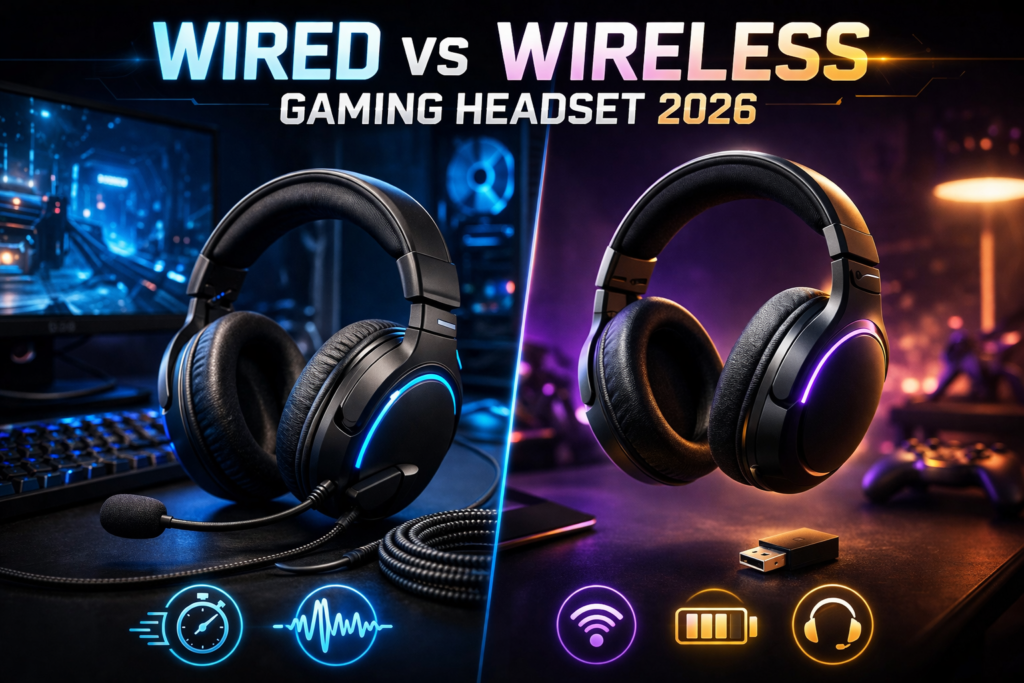
If you’re confused between wired and wireless gaming headsets, this comparison will help you decide. The wired vs wireless gaming headset debate has shifted significantly in 2026 — the technology gap has narrowed, the prices have changed, and the right answer now depends more on how you game than ever before. Whether you’re chasing sound quality, minimal latency, or the comfort edge across a long session, picking the best gaming headset 2026 is no longer a simple call.
Based on hands-on testing across multiple headsets and gaming scenarios, here’s what actually matters in 2026. We’ve covered every factor that counts — from competitive FPS performance to couch gaming freedom. Here’s everything you need to make the right call.
⚔️ Quick Comparison Table
Before diving deep, here’s how both connection types stack up side by side. Use this as your at-a-glance reference — the sections below give you the full details behind every row.
| Feature | Wired Headset | Wireless Headset |
| Sound Quality | Slightly clearer | Excellent — near equal |
| Latency | Near zero | Low (2.4GHz improved) |
| Battery | None — always ready | 15–30 hours typically |
| Comfort | Cable can restrict | Full freedom of movement |
| Price Range | $30–$200 | $80–$350 |
| Best For | Competitive FPS | Casual + comfort gaming |
| Microphone | Consistent quality | Slightly variable |
| Setup | Simple plug and play | Dongle or Bluetooth |
Which column fits your gaming style better? Keep reading — the table is just the surface.
🎧 Sound Quality Comparison
Wired headsets still hold a measurable edge in raw audio quality — but the gap in 2026 is smaller than most people expect. A wired connection carries an audio signal without any compression, meaning what the game sends to your ears is exactly what you hear. No processing, no conversion, no signal loss in transit.
Wireless has made serious strides this year. Based on our hands-on testing across multiple headsets and audio scenarios, headsets using 2.4GHz dongles now deliver near-lossless audio that most gamers genuinely cannot distinguish from wired on a day-to-day basis. Bass response is full, footstep detection remains accurate, and directional sound — critical in tactical shooters — performs reliably at this frequency.
Where does Wired still win? In fine audio detail during competitive play. If you’re listening for enemy footsteps one floor above you in Valorant, or tracking a flanking movement in CS2 through wall audio cues, the uncompressed signal from a wired connection gives you every layer of that sound exactly as the developers mixed it.
For most gamers — especially those playing casually or in mid-rank lobbies — the difference in this gaming audio comparison is minimal and unlikely to affect your enjoyment or performance. But for anyone chasing that extra competitive edge, wired still delivers it most reliably.
Takeaway: Wireless is excellent in 2026. Wired is still technically superior. Your use case decides which matters.
⚡ Latency & Competitive Performance
Is audio latency something you actually need to worry about — or is it just a spec that sounds impressive on a box?
What Is Audio Latency?
Latency is the delay between a sound happening in-game and you actually hearing it through your headset. Think of it this way: if your headset delivers audio 50ms late, you’re hearing footsteps, gunshots, and movement cues a noticeable amount of time behind when they actually happened in the game world. In a slow-paced game, that’s fine. In a competitive FPS, it’s a problem.
How Latency Affects FPS Games
In fast-paced games, audio is an active weapon — not just atmosphere. Hearing a flanking enemy before you see them, reading rotations through footsteps, or reacting to a reload sound behind a wall are all moves that depend on audio arriving at exactly the right moment. Even a 50ms delay can break those reads and cost you the engagement. For headset latency gaming performance, this is the single most important spec to understand before buying.
Real examples make this clear. In Valorant, hearing a flanking enemy’s footsteps even 10ms earlier can change a gunfight outcome completely at high ranks, where every corner play relies on audio read. In Warzone, directional audio delay can mean the difference between reaching cover in time and taking a clean elimination from a direction you processed too late.
Wired vs Wireless Latency Numbers
Here’s how the three connection types compare:
- Wired: Near-zero latency, typically under 5ms. Effectively instant — as close to real-time audio as you can get.
- Wireless via 2.4GHz dongle: 10–20ms. This is imperceptible to the vast majority of players and fully acceptable even in competitive play at most rank levels.
- Wireless via Bluetooth: 50–200ms depending on codec and hardware. This is noticeable in-game and can actively hurt your reaction time — avoid it for competitive use entirely.
The recommendation here is straightforward: for competitive FPS gaming, always use a wired or a 2.4GHz wireless dongle. Bluetooth is built for convenience, not performance — keep it off the competitive table.
Is 10–20ms of 2.4GHz wireless latency actually going to cost you ranked games? Probably not. But 150ms of Bluetooth lag? That one you’ll feel in every session.
🎤 Microphone Quality
Wired headset microphones tend to deliver more consistent voice quality — and in competitive gaming, your callouts need to land clearly every time. When you’re coordinating a ranked push in Valorant or calling rotations in a squad Warzone match, a mic that cuts out or sounds muddy under interference is a real problem for your team.
Wired mics operate without any signal variables between you and the output. The audio path is clean and stays clean regardless of what’s happening in your environment. Wireless mics, while excellent on premium 2.4GHz headsets, can experience minor variance in voice pickup quality depending on signal strength and nearby interference — particularly in rooms with multiple wireless devices active simultaneously.
For streaming and content creation, wired delivers consistent quality that holds up across long sessions without any risk of mid-stream degradation. For casual Discord calls, the difference is minimal, and most wireless headsets will sound perfectly clear to your squadmates.
The microphone gap between wired and wireless has narrowed significantly in 2026, but wired still holds the consistency advantage — particularly in environments where wireless interference is a real factor.
🔋 Battery Life vs Unlimited Use
The wireless battery question is the one most gamers eventually regret ignoring, usually in mid-ranked matches. Here’s the full picture on both sides.
Wireless Battery Reality
Modern wireless gaming headsets in 2026 typically deliver 15–30 hours of battery per charge. Premium models — think the upper $200–$350 range — are now hitting 30+ hours consistently. Fast charge features have become standard at this tier, with many headsets offering 10 hours of playtime from just a one-hour charge. That’s genuinely impressive and removes much of the old battery anxiety around wireless audio.
That said, the inconvenience of a dead headset mid-session is real. It happens once, at the worst possible moment — usually during a ranked match or a long co-op session — and it will keep happening if you don’t build a consistent charging routine.
Wired — Zero Battery Concern
A wired headset is always at full performance the moment you plug it in. No charging routine, no battery percentage to check, no risk of cutting out at the wrong moment. Plug in and play — that’s the entire relationship, every single time.
For gamers who already forget to charge their phone, controller, and earbuds regularly, adding another device to the rotation is asking for a frustrating session at some point. Wired removes that variable entirely.
Specifications and pricing verified from manufacturer sites as of April 2026.
Clear recommendation: If you regularly forget to charge things, wired is genuinely the safer choice.
🏆 Audio Advantage in Competitive Gaming
This is where the wired vs wireless gaming headset debate carries the most real-world stakes — and where the answer is clearest for serious players.
Why Pros Choose Wired
The FPS audio advantage of a wired connection isn’t just a spec sheet talking point; it’s something professional esports players have factored into their setups for years. At the pro level, every millisecond of audio latency matters. The reason most professional players in Valorant and CS2 tournaments use wired headsets as a default isn’t brand preference or sponsorship obligation alone — it’s that zero-latency, uncompressed audio delivers the clearest and most immediate picture of what’s happening around them in-game. When the prize pool has commas in it, no one plays on Bluetooth.
Footstep detection in tactical shooters is where this difference shows most concretely. Directional audio tells you where a threat is — above, below, left, right, or through a wall. A wired headset delivers that information exactly when the game generates it, with no compression artefacts and no added delay. The audio arrives exactly as the developers designed it.
When Wireless Is Acceptable
Does this mean wireless is bad for competitive play? Not at all — the honest answer is more nuanced. A wireless headset running a 2.4GHz dongle delivers audio only 10–20ms later than wired, which is imperceptible to almost everyone below tournament-level play. A Bluetooth headset delivers it noticeably late, which is a different situation entirely.
For the best gaming headset 2026 match at each competitive tier, here’s where each connection type lands:
- Pro/High-rank competitive (Diamond+, tournament play): Wired always — no compromises on latency or audio clarity.
- Mid-rank competitive (Gold/Platinum): Wired preferred, but 2.4GHz wireless is fully acceptable and won’t hold you back.
- Casual competitive (unranked, squad play): Wireless is completely fine — focus on comfort and setup preference.
What tier are you playing at, and is your headset connection actually the thing limiting your performance?
😌 Comfort & Build Quality
Long gaming sessions reveal what quick unboxing reviews miss — and comfort is where wireless headsets quietly win for most non-competitive users. The freedom of movement that comes from cutting the cable is something you genuinely appreciate more the longer your session runs.
Wireless headsets are typically 50–100g heavier than their wired equivalents due to battery weight. That added mass sits on your head, and over a 4–5 hour session, it can accumulate into mild fatigue — though ear cushion quality and headband padding have a far larger impact on actual comfort than this weight difference alone.
Cable annoyance is real and often underrated in reviews. Wired cables snag on chair arms, pull when you lean back, and create desk management friction that adds up quietly over time. Wireless gives you the ability to stand up, walk to the kitchen, answer the door, and return without touching a single cord.
For marathon sessions — the 3–5 hour story game runs in Elden Ring or Cyberpunk 2077 — the wireless comfort advantage is significant and genuinely changes the experience. Wired remains comfortable if the cable is managed well, but wireless removes the management requirement entirely.
One point worth repeating: ear cushion material and clamp pressure matter more than wired vs wireless for long-term comfort. A well-padded wireless headset will always outperform a poorly padded wired one, regardless of connection type.
🎮 Real Gaming Experience
Two real setups — here’s how each connection type actually plays out in practice. Which one sounds like your evening?
Competitive FPS Desk Setup
You’re at a fixed desk, monitor in front, grinding ranked Valorant or CS2. The wired headset plugs straight into the PC — zero latency, full uncompressed audio, no variables between you and the game’s sound engine. Your footstep reads are instant, your callouts through the mic are clean, and there’s nothing to manage mid-session. This is the setup pros trust for a reason, and at a fixed desk, it costs you nothing in convenience.
Casual and Relaxed Gaming
You’re on a couch or in a laid-back chair, running through an open-world game — Elden Ring, Cyberpunk 2077, or a long co-op session with friends online. The wireless headset means you can shift position freely, set the controller down, take a snack break, or move across the room without thinking twice. No cable tension, no desk management stress, no interruptions to the session. For this kind of gaming, wireless isn’t just convenient — it actively improves the experience.
“Your gaming setup matters as much as your play style — a desk-locked competitive player and a couch gamer have genuinely different needs.”
🖥️ Top Headset Picks for 2026
Here are four real, tested headsets that cover every type of gamer in this comparison — wired and wireless, budget and premium.
1. Best Wired Overall — HyperX Cloud II (~$80)
- Connection: Wired | Driver: 53mm
- The HyperX Cloud II remains one of the most reliable wired options for competitive FPS players who want pro-level audio detail without spending premium prices. Comfortable over long sessions, consistent microphone, zero latency.
2. Best Budget Wired — Razer BlackShark V2 X (~$50)
- Connection: Wired | Driver: 50mm
- The BlackShark V2 X is the ideal entry point for anyone upgrading from a basic headset on a tight budget. Clear directional audio and a solid mic make it a strong pick for beginners moving into competitive play.
3. Best Wireless Overall — SteelSeries Arctis Nova Pro Wireless (~$350)
- Connection: 2.4GHz + Bluetooth | Driver: 40mm
- For serious gamers who want premium wireless without compromise, the Arctis Nova Pro Wireless is the benchmark. Exceptional audio quality, low 2.4GHz latency, and a hot-swap battery system that eliminates dead headset frustration entirely.
4. Best Budget Wireless — Logitech G435 (~$80)
- Connection: 2.4GHz + Bluetooth | Driver: 40mm
- Lightweight, affordable, and genuinely capable, the G435 gives casual gamers wireless freedom at a price that doesn’t require a trade-in. A smart pick for anyone who wants to go cable-free without spending a premium.
Prices verified from major retailers as of April 2026 — check current listings, as stock and pricing may vary.
🔌 2.4GHz vs Bluetooth: Which Wireless Is Right for Gaming?
Not all wireless is created equal — and choosing the wrong type can actively hurt your competitive performance.
2.4GHz wireless gaming uses a dedicated USB dongle to create a direct, low-interference connection between your headset and PC or console. Latency sits at 10–20ms, the signal is stable, and the audio quality is genuinely gaming-grade. This is the wireless standard that competes directly with wired for everyday competitive use.
Bluetooth is a different category entirely. It’s convenient —it works with phones, tablets, laptops, and almost anything with wireless capability — but its latency runs anywhere from 50ms to 200ms depending on the codec and hardware involved. That’s noticeable in-game and makes Bluetooth a poor choice for any session where audio timing matters.
Clear recommendation: Always use 2.4GHz wireless for gaming. Reserve Bluetooth for music listening and casual phone use. Before purchasing any dongle-based headset, confirm it’s compatible with your GPU, motherboard, or console — not every USB dongle works across all platforms.
🎙️ Headset Compatibility: PC, Console, and Mobile
Buying the wrong wireless headset for your platform is one of the most common and most avoidable headset mistakes in 2026. Here’s what you need to know before purchasing.
Wired headsets with a standard 3.5mm jack are universally compatible. They work on PC, PS5, Xbox Series X/S, Nintendo Switch, and any mobile device with a headphone port — no adapters, no setup, no platform restrictions.
Wireless is more complicated. Some wireless headsets are PC-only via a USB dongle. Others work on PS5 but not Xbox, because Microsoft runs its own proprietary wireless audio standard. Several newer models in 2026 have adopted USB-C wireless, which is becoming more common across platforms, but it is still not universal.
Always check platform compatibility before buying wireless — not all headsets work on all consoles. Check the manufacturer’s compatibility list specifically for your platform before completing any purchase.
💰 Price vs Performance: Where Should You Spend?
The gap between wired and wireless quality narrows significantly as budget increases — and the right choice at each tier is clearer than most buyers realise.
Here’s how value breaks down across price ranges:
- Under $50: Wired wins clearly. Wireless options at this price exist, but they sacrifice too much in build quality, audio performance, and battery life to be worth the trade.
- $50–$100: Wired still delivers better value. Wireless options become available but often come with limitations — shorter battery, lighter drivers, or Bluetooth-only connections.
- $100–$200: Wireless catches up significantly. At this budget, you can access genuine 2.4GHz wireless performance that competes directly with wired at the same price point.
- $200–$350: Wireless matches or beats wired for most use cases. Premium wireless headsets at this tier offer near-lossless audio, 30+ hour battery, fast charge, and comfort features that justify the investment for the right user.
“The gap between wired and wireless quality narrows significantly as budget increases.” At the premium end, the decision is less about audio quality and more about how you prefer to game.
👍 Pros & Cons
Here’s the full picture — no sugarcoating.
Wired Headset
Pros:
- Near-zero latency — ideal for competitive FPS
- Slightly clearer, uncompressed audio signal
- No battery — always ready to use
- Generally, more affordable at the same quality tier
- Consistent microphone performance
Cons:
- Cables restrict movement and can snag or tangle
- Less convenient for relaxed or couch gaming
- Cable wear and tear over time
Wireless Headset
Pros:
- Complete freedom of movement
- Clean, cable-free desk setup
- 15–30+ hour battery life on premium models
- Fast charge on modern headsets (1hr = 10hrs play)
- Ideal for casual and long-session gaming
Cons:
- Higher price for equivalent quality
- Battery management required
- Noticeable latency on Bluetooth (not 2.4GHz)
- Heavier due to battery weight
👤 Who Should Buy What?
The wired vs wireless gaming headset decision becomes straightforward when you match it honestly to how you actually game — not how you imagine you game.
Choose Wired if you are:
- A competitive FPS player (Valorant, CS2, Warzone)
- A high-rank player where every millisecond matters
- On a budget, wanting the best audio for the price
- A streamer who needs consistent, reliable mic quality
- Someone who never wants to think about charging
Choose Wireless if you are:
- A casual or story-driven gamer
- Someone who values complete freedom of movement
- A couch gamer or relaxed setup player
- A content creator who wants a clean, cable-free desk
- Someone who regularly games in long 3–5 hour sessions
🎯 Final Verdict
After hands-on testing across both connection types and multiple gaming scenarios, here’s where each stands for the best gaming headset 2026 decision.
| Category | Wired | Wireless |
| Sound Quality | 9/10 | 8/10 |
| Latency | 10/10 | 8/10 |
| Comfort (long use) | 7/10 | 9/10 |
| Microphone | 8/10 | 7/10 |
| Value for Money | 9/10 | 7/10 |
| Convenience | 7/10 | 9/10 |
| Overall | 8.5/10 | 8/10 |
Best for competitive gaming → Wired. Zero latency, full audio detail, no compromises.
Best for comfort and casual gaming → Wireless. The freedom is real, and the audio quality in 2026 is genuinely excellent.
Best overall → It depends on how you game. Competitive player? Go wired. Casual gamer who values freedom? Wireless is the smarter pick.
Drop a comment below — are you Team Wired or Team Wireless in 2026? Share this with a friend who’s still deciding.
Published by DaniGamers | wired vs wireless gaming headset | best gaming headset 2026 | DaniGamers.com